One of the basic principles of Krsna consciousness is that one may utilize
whatever talent he has in the service of the Supreme Lord. And it is a symptom
of a bona fide spiritual master that he is expert in engaging everyone in
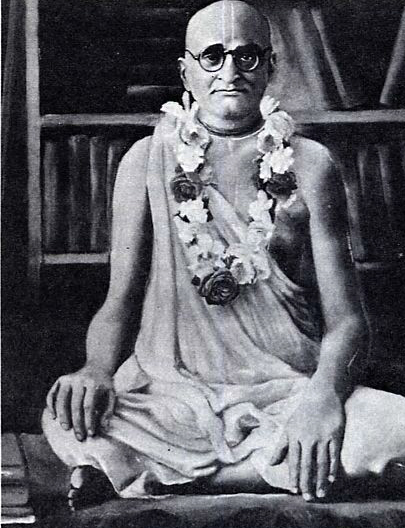
practical transcendental devotional service. His Divine Grace A.C.
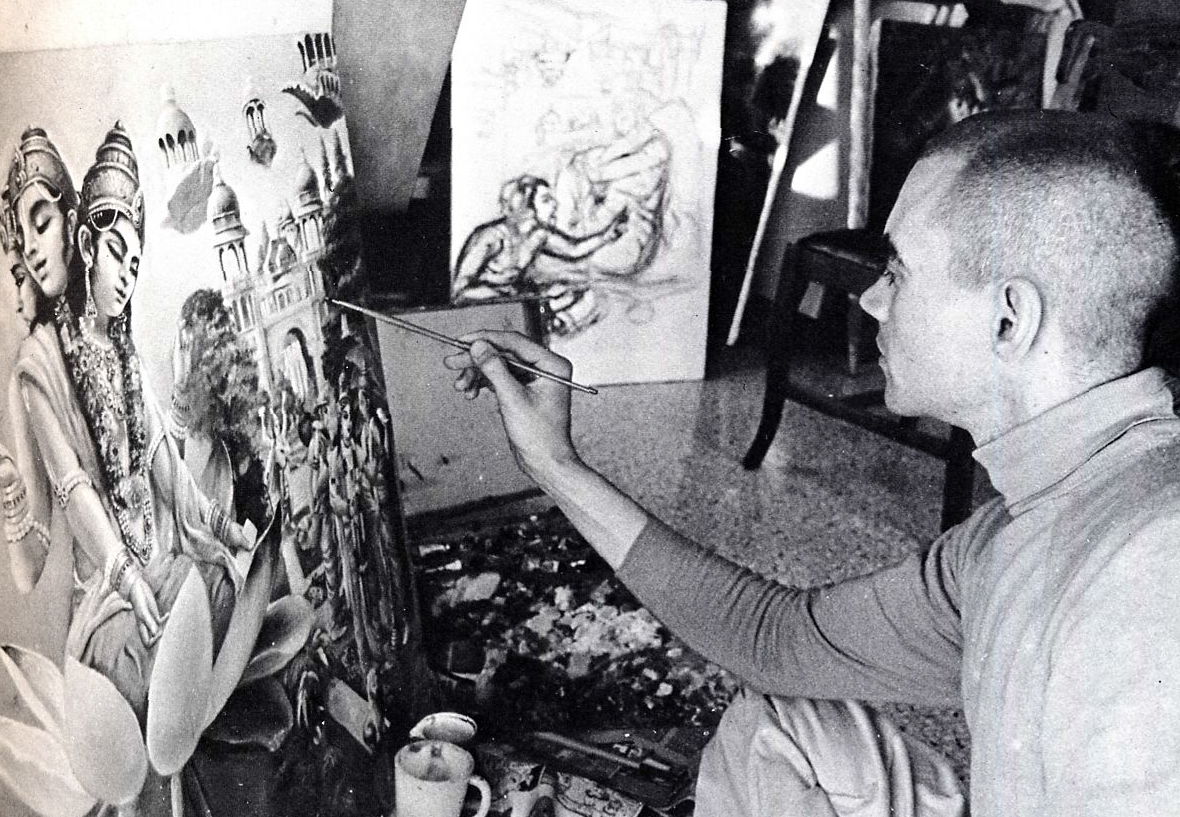
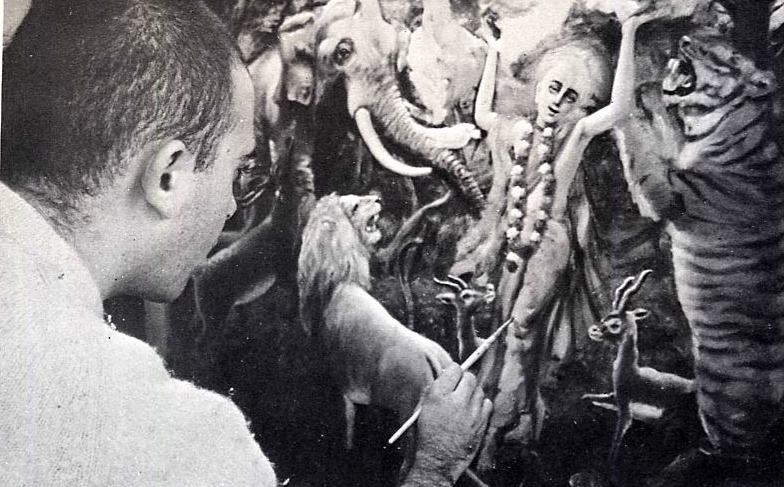
Bhaktivedanta Swami Prabhupada has thus engaged a number of very talented
artists in the service of the Lord by asking them to use their natural
artistic inclination in painting pictures of the Supreme Godhead. According to
all the revealed Vedic scriptures, God is not formless or void, but on the
contrary He has the most attractive personal form. In fact He has many
transcendental forms. Krsna appears and expands Himself in multi expansions
and incarnations, and these are described in Vedic literatures such as
Bhagavad-gita
and
Srimad-Bhagavatam
.
 His Divine Grace A.C. Bhaktivedanta Swami Prabhupada has written many books
and continues to translate authoritative books about Krsna for the benefit of
all mankind, and he has requested that this transcendental literature be
profusely decorated with illustrations. His Divine Grace has also founded many
temples of the International Society for Krishna Consciousness, and these are
transcendental centers where men and women may come and engage in spiritual
life by seeing the form of the Lord. Therefore paintings are needed in all the
temples, as well as for illustrations in books. For these two reasons an art
department has been set up in ISKCON for production of
Krsna-katha
art (art based on the pastimes of Krsna).
His Divine Grace A.C. Bhaktivedanta Swami Prabhupada has written many books
and continues to translate authoritative books about Krsna for the benefit of
all mankind, and he has requested that this transcendental literature be
profusely decorated with illustrations. His Divine Grace has also founded many
temples of the International Society for Krishna Consciousness, and these are
transcendental centers where men and women may come and engage in spiritual
life by seeing the form of the Lord. Therefore paintings are needed in all the
temples, as well as for illustrations in books. For these two reasons an art
department has been set up in ISKCON for production of
Krsna-katha
art (art based on the pastimes of Krsna).
If a painting is done according to authoritative descriptions, it has the same
potency as the Deity. According to the
Srimad-Bhagavatam
such paintings, when painted under authorized direction, in devotional
service, are also considered incarnations of the Lord. In other words, Krsna
is personally present in a picture of Krsna.
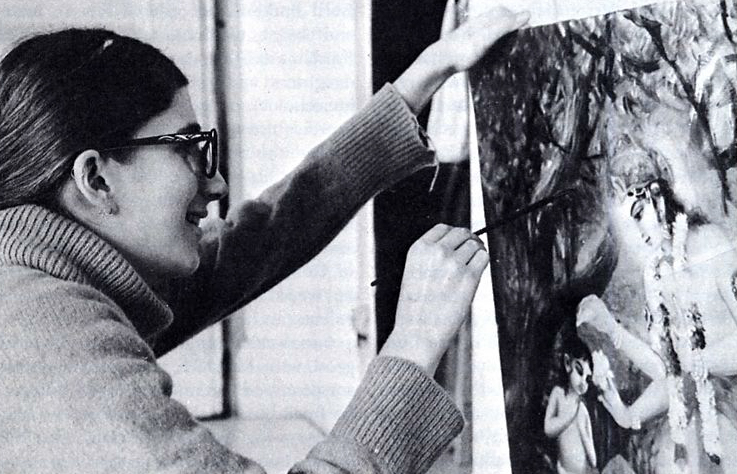
 His Divine Grace Srila Prabhupada first came to this country in 1965, and he
began at once to engage young artists in painting pictures to be hung in Krsna
conscious temples. Many of the artists began painting only in Krsna
consciousness, with no previous formal training. Srila Prabhupada wrote a
letter in April, 1968, to one such artist, Jadurani Devi, who was feeling
misgivings because she was not a highly developed artist. Srila Prabhupada
wrote as follows: “I know that pictures in this country are sold not on the
merit of the pictures but on the reputation of the artists. That system is
also current in India. But to come to the point of being a reputed artist will
require a long duration of time, and our time is very short. We have to finish
our Krsna consciousness during our lifetime, and we should not waste a single
moment for anything else. According to
Caitanya-caritamrta
a man is famous who is known as a great devotee of Krsna.
His Divine Grace Srila Prabhupada first came to this country in 1965, and he
began at once to engage young artists in painting pictures to be hung in Krsna
conscious temples. Many of the artists began painting only in Krsna
consciousness, with no previous formal training. Srila Prabhupada wrote a
letter in April, 1968, to one such artist, Jadurani Devi, who was feeling
misgivings because she was not a highly developed artist. Srila Prabhupada
wrote as follows: “I know that pictures in this country are sold not on the
merit of the pictures but on the reputation of the artists. That system is
also current in India. But to come to the point of being a reputed artist will
require a long duration of time, and our time is very short. We have to finish
our Krsna consciousness during our lifetime, and we should not waste a single
moment for anything else. According to
Caitanya-caritamrta
a man is famous who is known as a great devotee of Krsna.
 “Continue trying your best to make your pictures as nice looking as possible,
but not to satisfy the senses of the rascal public. Yesterday I was in a
Unitarian Church, and I saw there two pictures of logs and bamboos, and then
it was explained to me by our artist Govinda dasi that these are modern art
abstract paintings. Anyway I couldn’t see in them anything but a combination
of logs and bamboos. There was nothing to impel my Krsna consciousness. If you
want to be a great artist in that way, I will pray to Krsna to save you. If
the public doesn’t buy, we don’t mind. Why are you anxious to sell? We shall
distribute them to devotees without any price.
“Continue trying your best to make your pictures as nice looking as possible,
but not to satisfy the senses of the rascal public. Yesterday I was in a
Unitarian Church, and I saw there two pictures of logs and bamboos, and then
it was explained to me by our artist Govinda dasi that these are modern art
abstract paintings. Anyway I couldn’t see in them anything but a combination
of logs and bamboos. There was nothing to impel my Krsna consciousness. If you
want to be a great artist in that way, I will pray to Krsna to save you. If
the public doesn’t buy, we don’t mind. Why are you anxious to sell? We shall
distribute them to devotees without any price.
 “In the beginning I was seriously corresponding with some Indian friends to
get some good
mrdanga
players for our
sankirtana
street chanting, but when I found it too difficult to get a man from India,
some of my students were given the rudimentary lessons in playing, and simply
by practice they are now pulling on with
sankirtana
parties everywhere. My Guru Maharaja used to say that in a foreign land where
one cannot speak the language with the natives very nicely, what does he do to
get help when there is a fire in his house? In such an emergency one must
express himself somehow or other to his foreign friends and get their help to
extinguish the fire. But if he wants to learn the language first and then talk
with the foreign friends to get help, then everything in the meantime will be
finished. Similarly, if we have to learn and then paint, it will be a
long-term affair. But we want so many pictures immediately for all of our
books. So all the artists may always engage in painting works, and that
painting itself will gradually teach them how to make things nice. Regarding
organization of the artists, there is no need to waste time learning art from
studying texts. We should always remember that our time is very short. I think
that our artists should be satisfied with whatever they have learned
already—that is sufficient. They should simply engage in painting pictures
always, and that will sufficiently teach them the art.
“In the beginning I was seriously corresponding with some Indian friends to
get some good
mrdanga
players for our
sankirtana
street chanting, but when I found it too difficult to get a man from India,
some of my students were given the rudimentary lessons in playing, and simply
by practice they are now pulling on with
sankirtana
parties everywhere. My Guru Maharaja used to say that in a foreign land where
one cannot speak the language with the natives very nicely, what does he do to
get help when there is a fire in his house? In such an emergency one must
express himself somehow or other to his foreign friends and get their help to
extinguish the fire. But if he wants to learn the language first and then talk
with the foreign friends to get help, then everything in the meantime will be
finished. Similarly, if we have to learn and then paint, it will be a
long-term affair. But we want so many pictures immediately for all of our
books. So all the artists may always engage in painting works, and that
painting itself will gradually teach them how to make things nice. Regarding
organization of the artists, there is no need to waste time learning art from
studying texts. We should always remember that our time is very short. I think
that our artists should be satisfied with whatever they have learned
already—that is sufficient. They should simply engage in painting pictures
always, and that will sufficiently teach them the art.
 “In this connection I may remark that you have sent one picture of Narada Muni
which I understand was copied from a so-called great artist, but Narada Muni’s
body appears to be very sensuous. But he was a first-class
brahmacari.
He cannot have such a sensuous body. So you will do well not to work from the
so-called well-known artists, but you should follow exactly the descriptions
in the scriptures. The picture of Narada Muni which you painted in my presence
was very nice and good-looking, but this picture here doesn’t appeal to me.
Better not to worry about this sort of technique and style now.”
“In this connection I may remark that you have sent one picture of Narada Muni
which I understand was copied from a so-called great artist, but Narada Muni’s
body appears to be very sensuous. But he was a first-class
brahmacari.
He cannot have such a sensuous body. So you will do well not to work from the
so-called well-known artists, but you should follow exactly the descriptions
in the scriptures. The picture of Narada Muni which you painted in my presence
was very nice and good-looking, but this picture here doesn’t appeal to me.
Better not to worry about this sort of technique and style now.”
 Srila Prabhupada has guided his artists
to the transcendental level in art. It is only by the blessings of the
spiritual master that one achieves any success in spiritual life. It is said
in
Bhagavad-gita
that the perfection of any prescribed duty is to please Krsna, and one can
please Krsna by pleasing the spiritual master or the pure devotee of Krsna.
Therefore the artists who are pleasing the spiritual master are using their
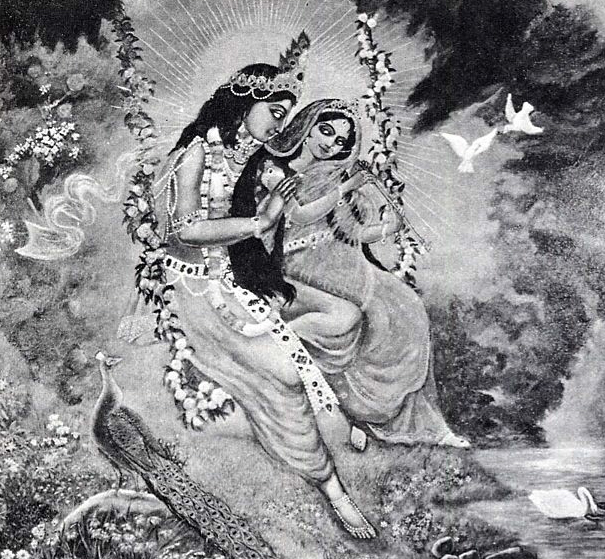
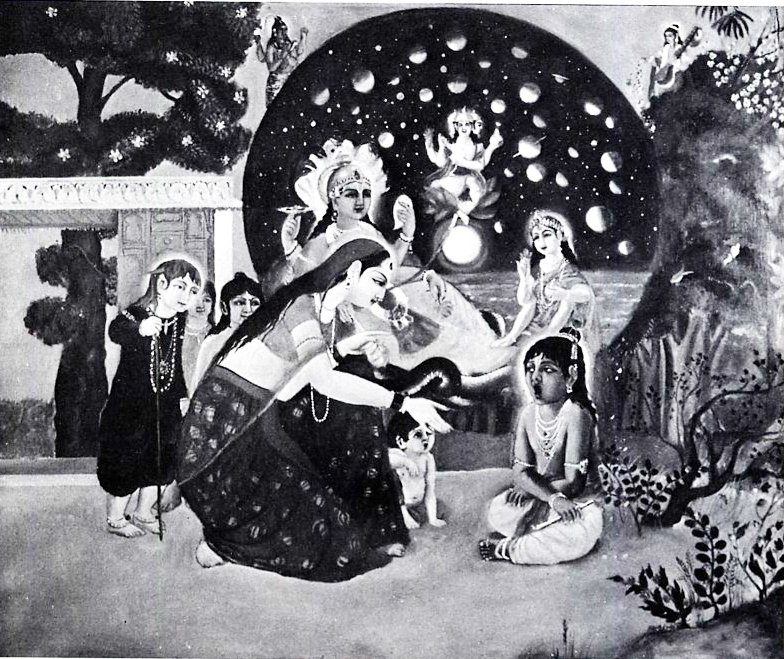
talent for liberation. Moreover, the paintings shown on these pages, which can
be seen in the various publications of ISKCON Press and in the temples of
ISKCON, not only liberate the artists, but they also attract other people to
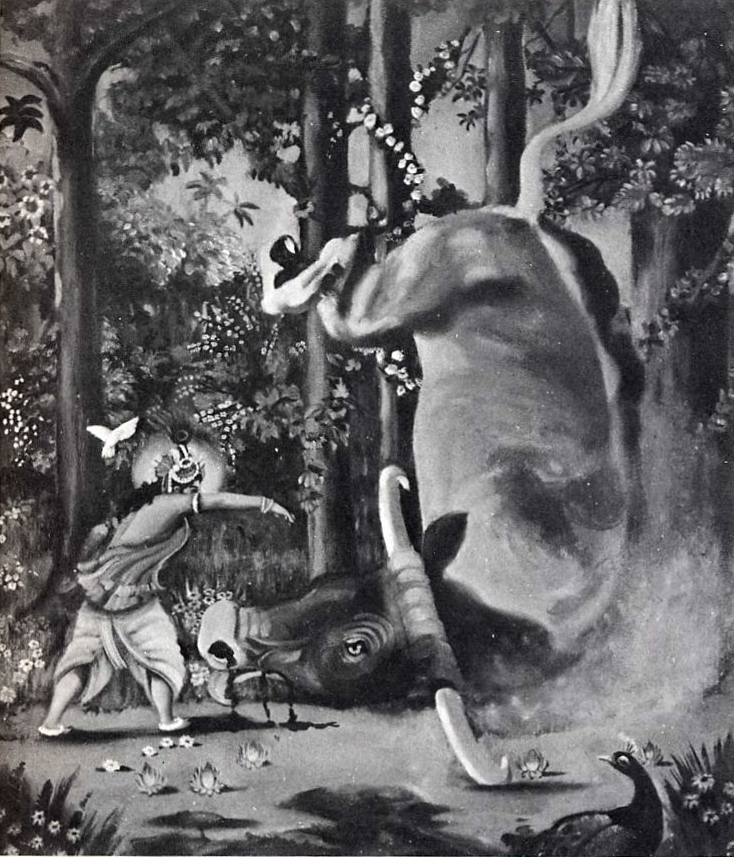
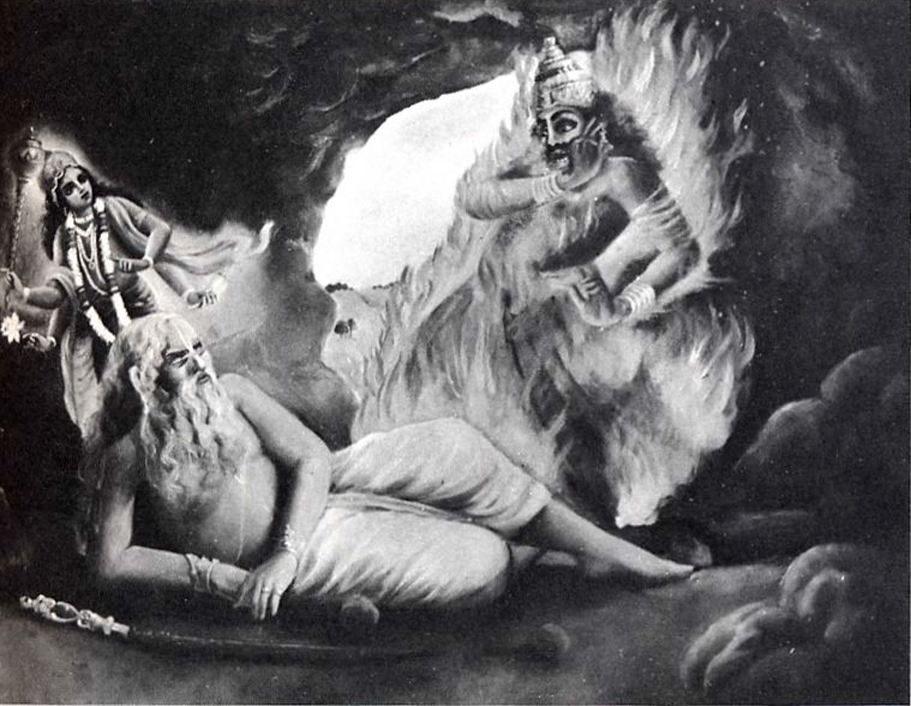
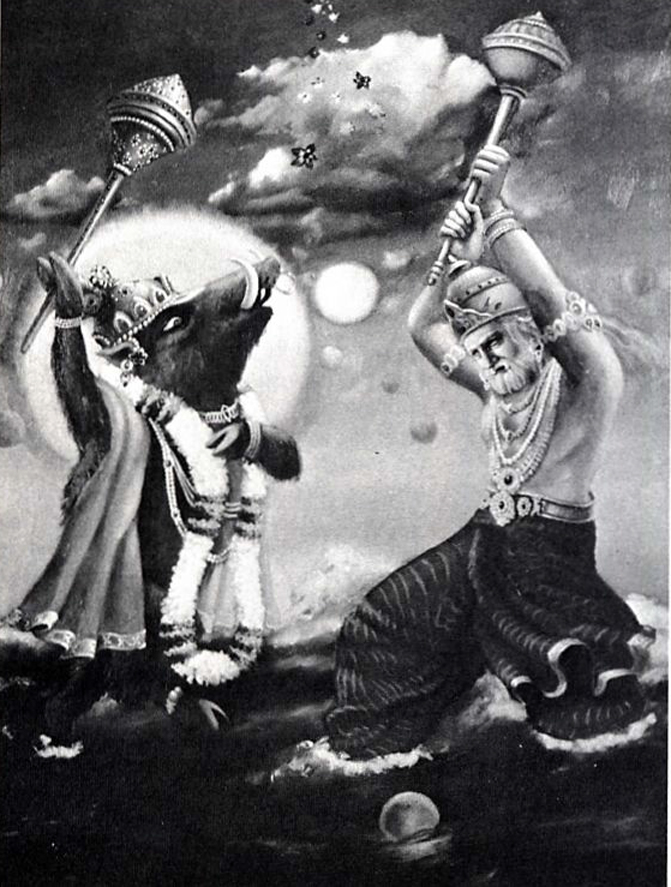
the transcendental form of Krsna. Up to date the most notable effort of the
art department has been the production of the fifty-five illustrations of
Srila Prabhupada’s book,
Krsna, the Supreme Personality of Godhead
. Srila Prabhupada wrote that people are attracted to the book simply on the
basis of the pictures, which very nicely explain the scriptural narrations.
Srila Prabhupada has guided his artists
to the transcendental level in art. It is only by the blessings of the
spiritual master that one achieves any success in spiritual life. It is said
in
Bhagavad-gita
that the perfection of any prescribed duty is to please Krsna, and one can
please Krsna by pleasing the spiritual master or the pure devotee of Krsna.
Therefore the artists who are pleasing the spiritual master are using their
talent for liberation. Moreover, the paintings shown on these pages, which can
be seen in the various publications of ISKCON Press and in the temples of
ISKCON, not only liberate the artists, but they also attract other people to
the transcendental form of Krsna. Up to date the most notable effort of the
art department has been the production of the fifty-five illustrations of
Srila Prabhupada’s book,
Krsna, the Supreme Personality of Godhead
. Srila Prabhupada wrote that people are attracted to the book simply on the
basis of the pictures, which very nicely explain the scriptural narrations.
 Krsna consciousness is a personal philosophy, and the spiritual master is
always personally thinking of his artists. Someone recently complimented Srila
Prabhupada on the fine artwork in his book
Krsna
, and he said, “But the persons who painted these are even more beautiful
shall the pictures.” In another letter to one of his art students, Srila
Prabhupada wrote, “You may inform the artists that I am always satisfied by
their work. I am satisfied only to see that everyone is always engaged in his
respective duties. The teacher wants to see that the students are engaged in
their handwriting work. As to who is writing with a nice hand, that is the
secondary question. The teacher’s first duty is to see that everyone is
engaged in handwriting. So if all the artists are always engaged in painting,
that will satisfy me, and that will gradually make them experienced in making
good paintings.”
Krsna consciousness is a personal philosophy, and the spiritual master is
always personally thinking of his artists. Someone recently complimented Srila
Prabhupada on the fine artwork in his book
Krsna
, and he said, “But the persons who painted these are even more beautiful
shall the pictures.” In another letter to one of his art students, Srila
Prabhupada wrote, “You may inform the artists that I am always satisfied by
their work. I am satisfied only to see that everyone is always engaged in his
respective duties. The teacher wants to see that the students are engaged in
their handwriting work. As to who is writing with a nice hand, that is the
secondary question. The teacher’s first duty is to see that everyone is
engaged in handwriting. So if all the artists are always engaged in painting,
that will satisfy me, and that will gradually make them experienced in making
good paintings.”
 While Krsna was being painted, Srila Prabhupada was sent samples of paintings,
and he commented in a letter to one of his artists: “The art department is
doing very nicely, and surely the production will improve even more by the
grace of Krsna. You are all being inspired by Krsna how to portray the Lord
and His associates for the devotees’ eyes, so everyone who sees these
transcendental pictures will turn to become a devotee, and that is our aim.”
Srila Prabhupada has seen from the beginning that Krsna conscious art is a
strong and convincing means to engage people in Krsna consciousness. He has
described the paintings as shutters which open the spiritual world for view,
and he has requested the artists to flood the world with their paintings.
While Krsna was being painted, Srila Prabhupada was sent samples of paintings,
and he commented in a letter to one of his artists: “The art department is
doing very nicely, and surely the production will improve even more by the
grace of Krsna. You are all being inspired by Krsna how to portray the Lord
and His associates for the devotees’ eyes, so everyone who sees these
transcendental pictures will turn to become a devotee, and that is our aim.”
Srila Prabhupada has seen from the beginning that Krsna conscious art is a
strong and convincing means to engage people in Krsna consciousness. He has
described the paintings as shutters which open the spiritual world for view,
and he has requested the artists to flood the world with their paintings.
 The authenticity of the paintings depends on the devotees’ scrupulously
following the scriptures. Descriptions of the Supreme Lord are given
throughout the Vedic literature, where His beautiful form is described in
detail. For instance, in a purport of the
Bhagavad-gita As It Is
His Divine Grace Srila Prabhupada, offering information from the
Brahma-samhita,
says, “The ideal
yogi
concentrates his attention on Krsna, who is called Syamasundara. He is as
beautifully colored as a cloud, and His lotus face is as effulgent as the sun.
His dress is brilliant, He is decorated with earrings, and His body is
flower-garlanded. Illuminating all sides is His gorgeous luster, which is
called the
brahmajyoti.
He incarnates in different forms like Rama, Nrsimha, Varaha and Krsna, the
Supreme Personality of Godhead, and He descends like a human being as the son
of mother Yasoda. He is known as Krsna, Govinda and Vasudeva. He is the
perfect child, husband, friend and master, and He is full with all opulences
and transcendental qualities. If one remains fully conscious of these features
of the Lord, he is called the highest
yogi
.”
The authenticity of the paintings depends on the devotees’ scrupulously
following the scriptures. Descriptions of the Supreme Lord are given
throughout the Vedic literature, where His beautiful form is described in
detail. For instance, in a purport of the
Bhagavad-gita As It Is
His Divine Grace Srila Prabhupada, offering information from the
Brahma-samhita,
says, “The ideal
yogi
concentrates his attention on Krsna, who is called Syamasundara. He is as
beautifully colored as a cloud, and His lotus face is as effulgent as the sun.
His dress is brilliant, He is decorated with earrings, and His body is
flower-garlanded. Illuminating all sides is His gorgeous luster, which is
called the
brahmajyoti.
He incarnates in different forms like Rama, Nrsimha, Varaha and Krsna, the
Supreme Personality of Godhead, and He descends like a human being as the son
of mother Yasoda. He is known as Krsna, Govinda and Vasudeva. He is the
perfect child, husband, friend and master, and He is full with all opulences
and transcendental qualities. If one remains fully conscious of these features
of the Lord, he is called the highest
yogi
.”
 Srila Prabhupada has encouraged the artists to work nicely together. He has
said that by painting together and discussing the subject matter of their work
they will remain in
samadhi,
or absorption in constant thought of the Personality of Godhead. One cannot
imagine how fortunate one must be to meet a bona fide spiritual master, for it
is only with the guidance of such a spiritual master that one can perfect
one’s life. The Krsna conscious art students always scrupulously follow the
descriptions in the scriptures. Also, the spiritual master, Srila Prabhupada,
has often given them additional descriptions. A team of four artists—Devahuti
Devi, Jadurani Devi, Muralidhara Das, and Bharadraja Das—painted the
illustrations for Krsna, and they received many specific instructions. For
example in the second volume of Krsna there is a description in the text of
prayers offered unto the Supreme Personality of Godhead by the personified
Vedas,
but there is not much reference to their appearance. So the artists asked
Srila Prabhupada, and in a letter of May, 1970, he replied: “The personified
Vedas
are just like great sages in appearance. Some of them may look like Vvasadeva,
Valmiki, Narada, etc. Some of them are older, some of them are younger, some
of them have full hair like Vyasa because they are householders, and others
are
brahmacaris,
with shaved heads, but they are all great souls,
paramahamsas,
highly elevated in the transcendental science. As you suggest, these pictures
will be needed for illustrating a long portion of text describing the prayers
It is a very important chapter, and it should be appropriately illustrated.
You are very able to choose suitable subject matter for the pictures, so
please execute them carefully for Krsna’s satisfaction. If you need any other
information, please write your inquiry to me, and I shall be glad to give you
the proper direction.” On occasion the spiritual master has corrected the
artists, as in a letter of 20 August 1970 regarding a picture showing the
great sage Sukadeva reciting
Srimad-Bhagavatam
to the renowned King Maharaja Pariksit: “This picture is not to the point.
Sukadeva Gosvami should be offered a nice raised throne, and King Pariksit
should be sitting along with the sages on the floor on the bank of the Ganges.
King Pariksit has no beard. His face should be very nice looking. He is a
young king, between thirty and forty years of age.” Srila Prabhupada, however,
has also told the artists to work on their own: “The best thing will be that
you paint pictures to your best discretion. The controversial points you can
send to me, and I will send instructions. All of you are expert painters, so
your mutual decision for painting a picture is more valuable than my
suggestion. The descriptions are already given in the books, so it should not
be difficult to take out the points and prepare a sketch.” Such instructions
from the spiritual master, although seemingly dealing with artistic
techniques, reveal something of the extent of his philosophical realization.
One can acquire transcendental knowledge after thousands of years of yogic
meditation, or one can receive it in a minute by submissively accepting the
word of the self-realized spiritual master. For example a letter of June 22,
1970, describes how to paint Lord Visnu, the form of the Absolute Truth who is
seen by a
yogi
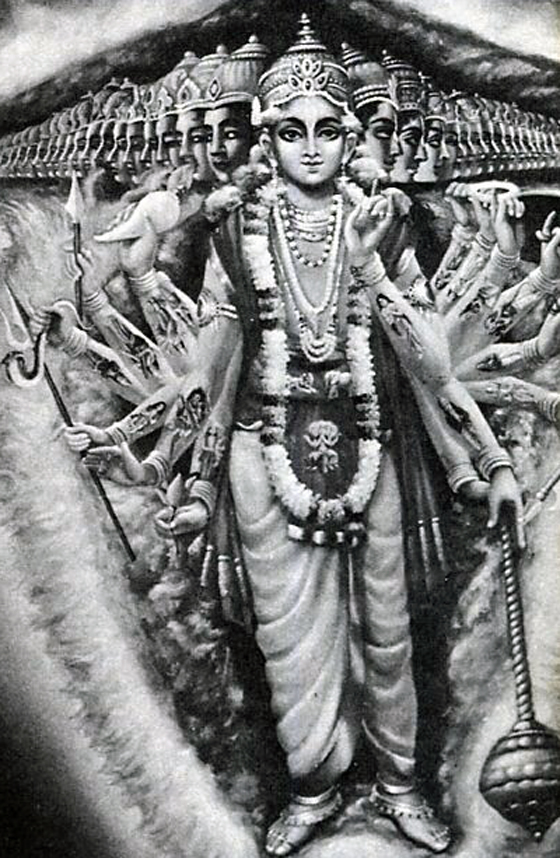
at the very culmination of his meditation. “Regarding the cover for
The Lord in the Heart,
Lord Visnu should be distinguished by Srivatsa on His chest. The Kaustubha
jewel should be painted to look like a very precious jewel. Lord Visnu should
be surrounded by an effulgence emanating from His person. The first
concentration should be on the lotus feet of the Lord. They should be very
distinct and very nicely decorated with jewels, sandalwood and
tulasi
.”
Srila Prabhupada has encouraged the artists to work nicely together. He has
said that by painting together and discussing the subject matter of their work
they will remain in
samadhi,
or absorption in constant thought of the Personality of Godhead. One cannot
imagine how fortunate one must be to meet a bona fide spiritual master, for it
is only with the guidance of such a spiritual master that one can perfect
one’s life. The Krsna conscious art students always scrupulously follow the
descriptions in the scriptures. Also, the spiritual master, Srila Prabhupada,
has often given them additional descriptions. A team of four artists—Devahuti
Devi, Jadurani Devi, Muralidhara Das, and Bharadraja Das—painted the
illustrations for Krsna, and they received many specific instructions. For
example in the second volume of Krsna there is a description in the text of
prayers offered unto the Supreme Personality of Godhead by the personified
Vedas,
but there is not much reference to their appearance. So the artists asked
Srila Prabhupada, and in a letter of May, 1970, he replied: “The personified
Vedas
are just like great sages in appearance. Some of them may look like Vvasadeva,
Valmiki, Narada, etc. Some of them are older, some of them are younger, some
of them have full hair like Vyasa because they are householders, and others
are
brahmacaris,
with shaved heads, but they are all great souls,
paramahamsas,
highly elevated in the transcendental science. As you suggest, these pictures
will be needed for illustrating a long portion of text describing the prayers
It is a very important chapter, and it should be appropriately illustrated.
You are very able to choose suitable subject matter for the pictures, so
please execute them carefully for Krsna’s satisfaction. If you need any other
information, please write your inquiry to me, and I shall be glad to give you
the proper direction.” On occasion the spiritual master has corrected the
artists, as in a letter of 20 August 1970 regarding a picture showing the
great sage Sukadeva reciting
Srimad-Bhagavatam
to the renowned King Maharaja Pariksit: “This picture is not to the point.
Sukadeva Gosvami should be offered a nice raised throne, and King Pariksit
should be sitting along with the sages on the floor on the bank of the Ganges.
King Pariksit has no beard. His face should be very nice looking. He is a
young king, between thirty and forty years of age.” Srila Prabhupada, however,
has also told the artists to work on their own: “The best thing will be that
you paint pictures to your best discretion. The controversial points you can
send to me, and I will send instructions. All of you are expert painters, so
your mutual decision for painting a picture is more valuable than my
suggestion. The descriptions are already given in the books, so it should not
be difficult to take out the points and prepare a sketch.” Such instructions
from the spiritual master, although seemingly dealing with artistic
techniques, reveal something of the extent of his philosophical realization.
One can acquire transcendental knowledge after thousands of years of yogic
meditation, or one can receive it in a minute by submissively accepting the
word of the self-realized spiritual master. For example a letter of June 22,
1970, describes how to paint Lord Visnu, the form of the Absolute Truth who is
seen by a
yogi
at the very culmination of his meditation. “Regarding the cover for
The Lord in the Heart,
Lord Visnu should be distinguished by Srivatsa on His chest. The Kaustubha
jewel should be painted to look like a very precious jewel. Lord Visnu should
be surrounded by an effulgence emanating from His person. The first
concentration should be on the lotus feet of the Lord. They should be very
distinct and very nicely decorated with jewels, sandalwood and
tulasi
.”
 Transcendental art as shown on these pages easily attracts one to the form of
the Supreme Personality of Godhead, and this is the perfection of human life.
This is confirmed in
Bhagavad-gita,
Chapter Twelve, verses 1-2: “Arjuna inquired: ‘Of those who are properly
engaged in Your devotional service, and those who are engaged by the
impersonal Brahman, the unmanifested—which is considered to be the more
perfect?’ The Supreme Personality of Godhead said: ‘He whose mind is fixed on
My personal form, always engaged in worshiping Me with great and
transcendental faith, is considered by Me to be most perfect.’ ” Out of His
infinite mercy, the Supreme Lord descends to this material world for the
pleasure of His devotees and to rescue all living entities who are dragging on
in this temporary world of miseries.
Transcendental art as shown on these pages easily attracts one to the form of
the Supreme Personality of Godhead, and this is the perfection of human life.
This is confirmed in
Bhagavad-gita,
Chapter Twelve, verses 1-2: “Arjuna inquired: ‘Of those who are properly
engaged in Your devotional service, and those who are engaged by the
impersonal Brahman, the unmanifested—which is considered to be the more
perfect?’ The Supreme Personality of Godhead said: ‘He whose mind is fixed on
My personal form, always engaged in worshiping Me with great and
transcendental faith, is considered by Me to be most perfect.’ ” Out of His
infinite mercy, the Supreme Lord descends to this material world for the
pleasure of His devotees and to rescue all living entities who are dragging on
in this temporary world of miseries.
 There is no one as successful as a disciple who uses his talent to serve Krsna
under the expert guidance of his bona fide spiritual master. A sincere seeker
of God consciousness will never minimize the importance of the spiritual
master. But someone may ask, “If God is everywhere, then what is the need of
the spiritual master?” The answer is contained in a comparison of the
spiritual master to an electrician. Electricity is everywhere, but it is
necessary for an electrician to come and make a connection before one can tap
the electric flow for one’s telephone or radio. In the same way, God is
present in His multi energies, but the pure devotee of God knows just how to
use these energies of the Lord in His service. Particularly, the pure devotee
spiritual master can show transcendental artists how to paint the personal
form of the Personality of Godhead. Because he is completely conversant with
the scriptures and is realized in love of Krsna, the spiritual master knows
all the intricacies of the appearance of Krsna. He can authorize an artist’s
work so that it becomes transcendentally worshipable as an
arca
incarnation, or incarnation of the Lord in material elements, such as in the
form of statuary or oil on canvas. As for the artists who accept such eternal
employment, their world becomes transformed from aimless vanity or from a
simple labor of love into the perfection of human existence—glorification of
God through one’s occupation. Therefore we offer our respectful obeisances
unto the spiritual master who is coming in disciplic succession from Lord
Caitanya.
There is no one as successful as a disciple who uses his talent to serve Krsna
under the expert guidance of his bona fide spiritual master. A sincere seeker
of God consciousness will never minimize the importance of the spiritual
master. But someone may ask, “If God is everywhere, then what is the need of
the spiritual master?” The answer is contained in a comparison of the
spiritual master to an electrician. Electricity is everywhere, but it is
necessary for an electrician to come and make a connection before one can tap
the electric flow for one’s telephone or radio. In the same way, God is
present in His multi energies, but the pure devotee of God knows just how to
use these energies of the Lord in His service. Particularly, the pure devotee
spiritual master can show transcendental artists how to paint the personal
form of the Personality of Godhead. Because he is completely conversant with
the scriptures and is realized in love of Krsna, the spiritual master knows
all the intricacies of the appearance of Krsna. He can authorize an artist’s
work so that it becomes transcendentally worshipable as an
arca
incarnation, or incarnation of the Lord in material elements, such as in the
form of statuary or oil on canvas. As for the artists who accept such eternal
employment, their world becomes transformed from aimless vanity or from a
simple labor of love into the perfection of human existence—glorification of
God through one’s occupation. Therefore we offer our respectful obeisances
unto the spiritual master who is coming in disciplic succession from Lord
Caitanya.